March 6, 2010 | Filed Under Education, Quilt Photography | Comments Off
Thanks to the Textile Art Resources Guide, I have found out about an article written by Paul Sugden for The Australian Forum for Textile Arts: Legally Speaking, Paul Sugden on Quilts, Photographs & Galleries. In this article, he discusses a conflict that that arose when a photographer who was hired by a gallery to take photos of an exhibit subsequently published the photos of the quilter’s artwork on his own website, claiming he had copyright of the photos.
Paul Sugden is the honorary lawyer for TAFTA and he lectures in the Department of Business Law and Taxation at the Berwick Campus of Monash University Melbourne. He writes regular columns for Textile Fibre Forum magazine, “Legally Speaking,” which are posted on the website. I haven’t had time to read all the articles yet but this appears to be a valuable resource. Although it is written from an Australian perspective, much of the commentary may also be relevant to other countries as international treaties dictate a fair degree of uniformity in copyright laws.
January 3, 2009 | Filed Under Quilt Photography, Technique:Design | 10 Comments
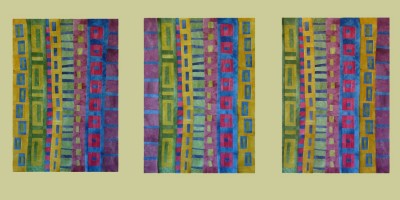
As I have mentioned before, I find my digital camera a very useful design tool. For example, this week I have been working on a small quilt (70×90cm) as a potential gift for friend that provides great hospitality when I travel to quilting events further afield. I was getting bogged down on what order to place the last couple of strips so I took some photos and placed them side by side for comparison.

Then I coloured the background to approximate the colour of my friend’s lounge room walls:

I immediately rejected one of the layouts but, in a holiday-induced vagueness, was wavering on the other two. A quick consultation with Erica, got me over this impasse and now I’ve nearly completed quilting the piece.
I did my mock-ups using Photoshop Elements but Robin has alerted me to the Mosaic Maker by Big Huge Labs.
I’ll show you the quilt when it is completed but which layout do you prefer?
October 3, 2008 | Filed Under Blog Admin, Quilt Photography | Comments Off
If you are reading this post, if means the weather forecast was right and rain is preventing me from accessing the internet. However, before the bad weather set in, I did catch enough time to schedule this post and place my order for Gloria Hansen’s new book Digital Essentials.
Gloria has always been so generous with sharing her knowledge via the Quiltart list and I am confident that the book will be full of useful tips for the 21st century artist and blogger. If nothing else, I encourage you to download Gloria’s FREE PDF file all about image protection and what steps you can take to protect your online images against unscrupulous copying.

Gloria is currently offering free shipping for US orders and, speaking of free shopping, Hancocks of Paducah is also offering free shipping for international and US orders. Enter code “FREESHIP” in the source code field during checkout. Domestic United States orders must be over $29.99, and International orders over $79.99 in order to qualify. Take advantage of no shipping charges on all orders until October 8, 2008. Hope I catch you in time Judy!
January 16, 2008 | Filed Under Quilt Photography, Technique:Piecing | Comments Off
I haven’t quite made it back to the sewing machine yet as I have been working on updating some of the instructions on patterns of my original quilt designs including Seaside Treasures:

Thanks to this useful tutorial for creating transparent backgrounds in Photoshop and Photoshop Elements, mentioned on Blogging Basics 101, I have been able to make up these images setting out the steps for piecing an hourglass block.
May 26, 2007 | Filed Under Quilt Photography | 2 Comments
I now remember why I haven’t updated my contemporary quilts website for a while. It’s because I wanted to use some better quilt images which means spending more time nutting out Photoshop Elements which has to be one of the most frustrating software applications around. Take this photo of my latest quilt, for example:

You will see that I have done a facing finish on the quilt (see my facing tutorial). Now to show this finish to its best effect, I would like to crop out the grey/white background. I know about the magic eraser and magic extractor tools in Photoshop, and I’ve watched this video tutorial and this video tutorial many times, BUT whenever I try to use these functions I end up with shaggy bits hanging off my quilts. So then I try to clean these bits using the manual eraser function except it doesn’t have the precision I’m looking for and I end up nudging the quilt so that it looks like Pac Man got loose. Of course the manual is of little or no assistance with the questions I have and I seem to waste vast amounts of time experimenting to no avail.
In the end, I usually retreat to the Arcsoft Photoimpression software that came with my camera. It’s pretty basic but it lets me do most things I want including cropping, resizing, fixing colour and lighting and adding text. However, I really would like to get on better speaking terms with Photoshop Elements so if anyone can recommend some useful online tutorials, please let me know!
May 18, 2007 | Filed Under Blog Admin, Quilt Photography | 2 Comments
As a 21st century quiltmaker with a digital camera, a blog, a website and occasional publication in the print media, I find it useful to understand the difference between low and high resolution digital images. More importantly, in order to better communicate with the viewers of my quilts, it is essential to understand the optimum resolution and file size requirements of different mediums.
To understand what I am getting at, just think how offputting it can be to come across a website or blog where the photos take F__O__R__E__V__E__R to load onto the screen. Typically what has happened, is that the owner of that site has taken a bunch of photos with their new, you-beaut multi-megapixel camera and simply posted the photos with no regard to the reader (especially those on dial-up) or even their own bandwidth bill. Another common scenario is where the site owner has made up a personalised banner-image but the file size is excessive.
Multi-megapixel cameras take high resolution images with a large file size for each image. This is great if you want to make a poster size print to put on your wall but it is not so good for posting online.
Conversely, I have seen cases where quiltmakers have been disappointed to open a newsletter or magazine and to see that their beautiful quilt photos have somehow become pixellated and fuzzy in the printing process. The problem, invariably, is that the photo was not prepared at 300 dpi (dots per inch) resolution at the size it was printed.
This information sheet Understanding DPI and Pixel Dimensions prepared by www.iprintfromhome.com explains how prepare your images for print publication purposes. (This was the company I used when I needed some slide images of my quilts to take to the workshop I did with Nancy Crow. I was very happy with the results.)
This collection of online tutorials shows you show you how to rotate, crop, resize, and batch process your images for optimum use on a web page.
October 17, 2006 | Filed Under Quilt Photography | Comments Off
Today’s assignment demonstrates that I have lots to learn about quilt photography and, in particular, lighting. Taking raw shots of my Autumn Splendour quilt as an example, you will see that I photographed each quilt under four conditions (clockwise): flash, no-flash, under lights and flash with lights. In virtually every case, the no-flash photo turned out best.

The “Going to Pieces” guild challenge quilts are a fantastic showcase of the talent within the guild and I look forward to sharing photos of the other forty quilts later in the week.
Lost & found update: I found my missing teaching aids. They were in the drawer where I thought I had placed them, only they had slipped down the back. Very sneaky.
October 14, 2006 | Filed Under Quilt Photography | 1 Comment
Today was unseasonably warm. Accordingly, after my morning swim and breakfast, I left David to his tan and headed for the air-conditioned comfort of the local mall. Apart from needing to restock the pantry, I was on a mission to replace my ailing iron and to buy a tripod for my digital camera. Here are my new quilting buddies:

An iron is an essential quilting tool yet, as noted on Lisa Call’s blog, finding an iron that can withstand the rigours of quiltmaking can be a challenge. My trusty iron never quite recovered from being knocked onto the floor earlier in the week. Then, to add insult to injury, I had managed to encrust the super teflon surface with some gunk from the pellon that I am using for the bags that I am making. Fortunately one of the department stores is having a mid-season sale and I was able to get the same make and model which has served me well (apart from the pesky beeping noise that accompanies the auto-off function).
The tripod is something that has been on my Christmas list for a while but the purchase was accelerated due to an impending photography assignment. In the absence of any other volunteers coming forward, I have agreed to photograph the forty odd “Going to Pieces” guild challenge quilts on Tuesday. Not that I purport to be an expert photographer. I will be re-reading the photography guide for textile artists generously compiled by Holly Knott and Any Baird.
You will be able to give me a scorecard (be gentle!) as I plan on posting images of some or all of the quilts on the guild website for which I am defacto webmaster. There are some fabulous quilts so I will post the link in due course.
April 24, 2006 | Filed Under Quilt Photography | Comments Off
Quilts can be pesky things to photograph well but your chances of getting good photos will be enhanced if you read and heed the thoughtful guidelines of Holly Knott and Andy Laird which are posted on Holly’s website at: www.hollyknott.com/stq/index.htm I’m sure that many of us will find this a useful resource.
February 17, 2006 | Filed Under Quilt Photography, Technique:Design | 4 Comments
I was reading Melody Johnson’s blog,Fibermania, back in January (her 27 January post to be precise) in which she remarks: The digital camera really has made such a difference in the way I work these days, with opportunities to change the way I view something or by printing out the image and making changes on the paper before I do it on the final piece.
It got me thinking about how much the digital camera has become integral to my own quiltmaking activities. Not only is it great for taking photos of quilts-in-progress and finished quilts so that I can share them with others by e-mail or by posting them on the web, but other handy uses include:
- auditioning fabrics from my stash for potential projects - both colour and grey scale photos are great ways of checking whether you have a good mix of values or if a particular fabric is going to leap out at you;
- when required, taking photographs of fabrics to send to the recipient of the proposed quilt to check that it will fit in with their decor (not that I often give people this choice!);
- auditioning block/colour placement in the course of quilt construction - you can photo all the different combinations; choose the one you like the best and refer back to that photo as you put the quilt/blocks together;
- checking block/colour placement as you go along . You don’t even need to take a photo for this - just looking through the lens can be enough to show you something is not quite right;
- making a reference shot of block/colour placement so that I can freeup the design wall for other projects (I’m not a one-quilt-at-a-time kind of quiltmaker!);
- auditioning borders - I take photos of my completed quilt centres,and import them into my EQ5 software. By using the appropriate scale, I can then mock up different size/multiple/colour/ style borders. This how I came up with the border in myBanana Flower Paradise quilt - I love how the border echoes the fringe of a banana leaf;

- incorporating a photo of some or all of the quilt for the quilt label which I print up on fabric sheets in my inkjet printer;
- incorporating photos into my quilts; and
- last, but not least, my digital photo albums represent my own little inspiration bank overflowing with design, palette, subject and composition ideas.
My digital camera was given to me as a farewell gift when I resigned as a partner in a law firm in 2003. It’s not a fancy model but it gets constant use. The law firm is holding an inaugural alumni event next week (I’ll be the one not wearing a suit although I promise not to wear my usual swimsuit/shorts attire) so I’ll be sure to tell them what a useful gift it has been.